
How To Choose A Design Training Program That Fits Your Career Goals?
How To Choose A Design Training Program That Fits Your Career Goals?
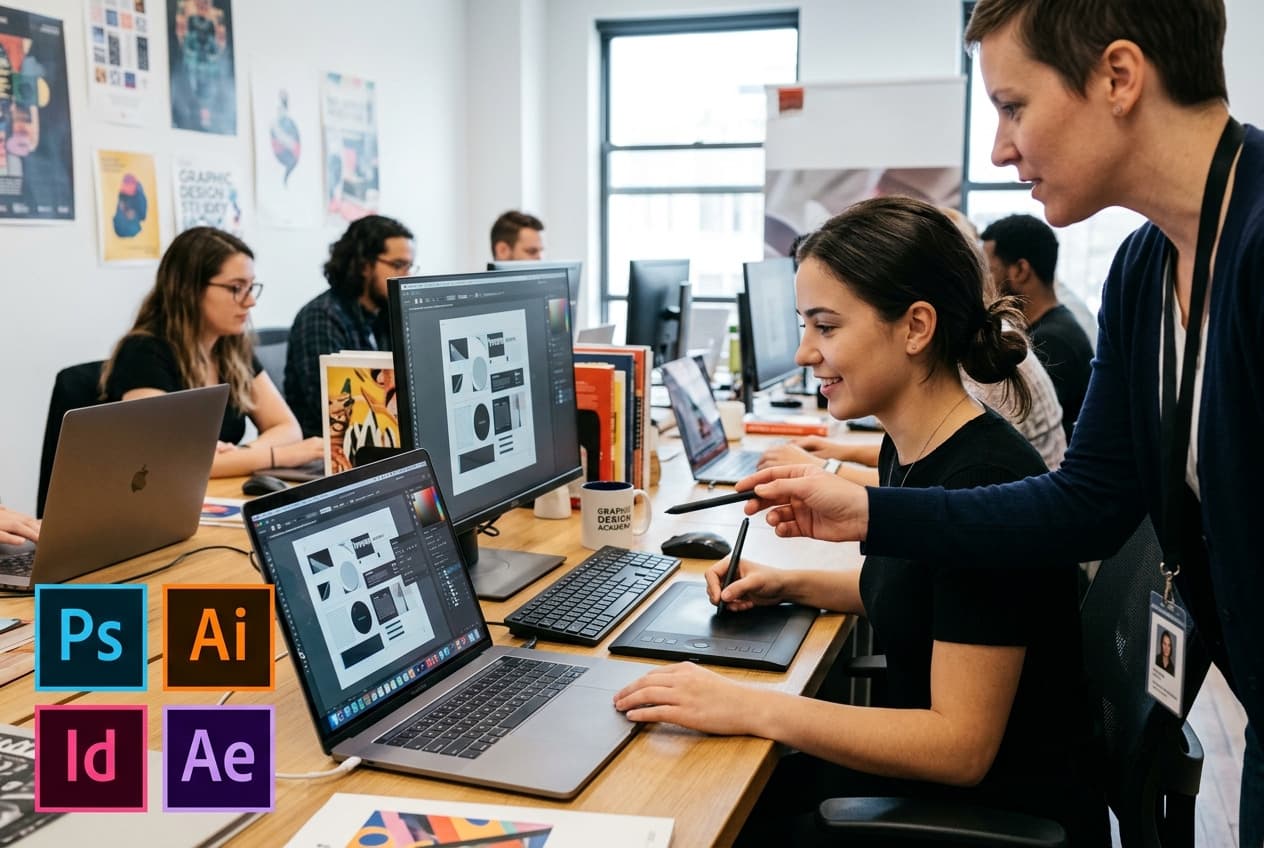
Getting graphic design training is not just an opportunity to learn how to use design programs, it may also be the step that determines how ready you are to work in this field. Choosing the right program does not depend only on the study duration or the number of tools you will learn, but on how well the training content matches your current level and the skills you need to achieve your career goal. Whether you are starting your journey of learning design from scratch, or want to develop your skills to move into a new job, it's important to look at the curriculum, the practical applications, the trainers' experience, and the type of certificate you will receive.
In today's article, we go over the most important criteria that help you choose the right graphic design training programs.
Why Should You Define Your Goal Before Choosing Any Graphic Design Training?
Defining your goal helps you choose the program that actually serves your needs instead of enrolling in a course that doesn't match your ambitions. So:
- If you're aiming to work as a graphic designer, you'll need a comprehensive graphic design diploma that includes design basics, using design programs, executing projects, and building a portfolio.
- If your goal is developing a personal skill or using design in your current job, then a short graphic design training course may be more suitable.
Whatever your goal is, Higher Saudi Skills Institute offers the best certified courses and diplomas in graphic design, with a select group of the best specialized trainers, alongside providing practical training and real-world projects that qualify you for the job market.
Do You Want To Learn Graphic Design To Work, Or To Develop A Personal Skill?
If your goal is to work in graphic design, it's better to choose comprehensive graphic design training that focuses on the practical side and gives you the opportunity to execute a variety of projects, along with getting a certificate that supports your professional qualification.
If you want to learn design as a hobby or to develop a personal skill, you can start with a short course that focuses specifically on the tools and skills you need.
What Is The Difference Between Graphic Design Training And Interior Design?
The main difference lies in the nature of the field and the skills used, as:
- Graphic design training focuses on creating two-dimensional visual content, such as logos, visual identities, advertisements, digital posts, and printed materials, using specialized design programs.
- Interior design, on the other hand, is related to planning and coordinating interior spaces and choosing colors, materials, furniture, and lighting, while taking into account both the function and aesthetic aspects of the space.
Alongside the graphic design diploma and short courses offered by Higher Saudi Skills Institute, the institute also offers a certified interior design diploma for those who want to develop their skills in this field from scratch to professional level.
How Do You Determine Your Level Before Enrolling In Any Graphic Design Training Courses?
Knowing your current level helps you choose graphic design training that suits your needs, instead of enrolling in an advanced course that's hard to keep up with, or a beginner program that doesn't add to your experience.
You can assess your level through several points:
- Beginner: If you have never studied design before and don't know color theory, typography, or composition, or how to use design programs.
- Intermediate level: If you know design principles and use some programs, but need to develop your skills and execute more professional projects.
- Advanced: If you are able to execute various designs and have a portfolio, and you're looking to develop a specific specialization or improve your professional work level.
What Skills Should Graphic Design Training Programs Include?
Good graphic design training doesn't focus on teaching design tools only, but combines the artistic side with technical skills and practical application.
Among the most important skills it should preferably include:
- Design basics: composition, balance, contrast, visual hierarchy, and white space.
- Color theory: choosing and coordinating colors and understanding their effect on the design's identity and the brand's message.
- Typography: choosing the right fonts, formatting text, and achieving harmony between written and visual elements.
- Visual identity: designing logos and elements that reflect the brand's personality.
- Print design: such as brochures, booklets, cards, and promotional materials.
- Digital design: preparing posts, ads, and content for digital platforms with the right sizes and formats.
- Working with images and graphics: editing images and creating and preparing visual elements for use.
- Practical application: executing real projects or simulations of client projects, rather than relying only on theoretical explanation.
- Building a portfolio: choosing the best projects and arranging them in a way that helps showcase the designer's skills to employers and clients.
What Practical Programs Should Be Trained On In Graphic Design?
Choosing the programs depends on the nature of the specialization, but there is a set of basic tools that a designer needs to know how to use in any graphic design training:
| Program | Main Uses |
| Adobe Photoshop | Editing images, image processing, designing ads, posts, and digital content |
| Adobe Illustrator | Designing logos, vector graphics, icons, and visual elements |
| Adobe InDesign | Designing books, magazines, brochures, booklets, and multi-page files |
| Adobe After Effects | Adding motion and effects and creating animations and moving visual content |
How Do You Evaluate The Quality Of The Curriculum And Trainer In Any Graphic Design Training?
Before enrolling, don't just look at the program's name or the number of hours, try to find out what you will actually come out with after the training ends.
You can evaluate the quality of the program through:
- Comprehensiveness of the curriculum: Does it start from design basics and then move on to advanced skills, or does it focus only on using programs?
- The practical side: Does it include real projects and applications, or does it rely mainly on theoretical explanation?
- How the content relates to the job market: Do you train on designing visual identity, ads, digital content, print materials, and other tasks a designer carries out in their work?
- The trainer's experience: It's important for the trainer to have strong knowledge of the field and the ability to explain concepts and give clear feedback on trainees' work.
- Direct training: Having the opportunity to ask questions and get guidance while executing projects makes the learning experience more useful.
- Type of certificate: If your goal is professional, check the nature of the certificate, the party issuing it, and how accredited it is.
In this regard, Higher Saudi Skills Institute offers certified graphic design training programs in person at the institute's premises, with a focus on combining knowledge with practical application.
Why Are Applied Projects Important In Graphic Design Training?
The applied project is the stage where what you've learned turns into a usable skill. Knowing Photoshop or Illustrator tools alone doesn't necessarily mean you're able to execute a design that meets a client's needs.
Practical projects in any graphic design training help with:
- Turning knowledge into skill: you learn how to apply design principles instead of just memorizing them theoretically.
- Dealing with real requirements: such as understanding the project idea, defining the audience, choosing the visual style, and organizing design elements.
- Discovering weak points: you may discover during application that you need to develop your skills in colors, composition, or working with fonts.
- Practicing problem-solving: a designer doesn't always work according to a ready-made idea, but needs to find suitable visual solutions for the goal.
Do You Need A Certified Certificate Or A Specific Skill?
The answer depends on your goal, because the certificate and the skill don't serve the same purpose, and the following table shows you what you actually need:
| Certified Certificate | Practical Skill | |
| Main goal | Proving completion of a training program according to specific requirements | Proving your ability to execute design work |
| Importance for beginners | Gives them a documented qualification that helps at the start of their path | Helps them turn what they've learned into actual work |
| Importance for employment | May be required or supportive for some jobs | An important factor when evaluating a designer's level |
| What it proves | That you completed the program and got the certificate | That you can execute design with suitable quality |
| Best approach | Get it from a trusted training provider | Keep developing it through projects and practice |
How Do You Compare A Short Course And A Diploma For Learning Design From Scratch?
If you're starting to learn graphic design from scratch, it's not enough to compare the duration or price of programs, you need to look at what you will actually get from each option.
The following table shows you the difference between the diploma and the short course:
| Short Course | Diploma | |
| Study duration | Shorter and suits those who want to learn within a limited period | Longer because it covers the field more comprehensively |
| Content | Usually focuses on basics or specific skills | Covers design principles, programs, applications, and different design areas |
| Practical application | A limited number of applications and projects | More projects and applications that help solidify skills |
| Goal | Gaining a specific skill or getting familiar with the field | Building comprehensive qualification and readiness for a career path |
| Certificate | Varies depending on the provider and program | Usually more suitable for those seeking a documented professional qualification |
So, if your goal is just getting familiar with the field or learning a specific tool, short graphic design training may be enough.
But if you want to move from beginner to a level that qualifies you to work, the comprehensive diploma is a more thorough option.
What Are The Common Mistakes When Choosing A Graphic Design Training Program?
Some people choose a program based only on the ad or the price, then discover after enrolling that the content doesn't match their goal.
Among the most notable mistakes it's best to avoid:
- Choosing a program just because it's short: a short training duration doesn't necessarily mean it's better or more effective.
- Not reviewing the curriculum: you need to know exactly which topics and skills you'll learn before enrolling.
- Focusing on programs without design principles: learning Photoshop or Illustrator is important, but it's not enough without understanding composition, colors, fonts, and so on.
- Neglecting the practical side: training that relies on explanation without projects may not give you enough experience.
- Not checking the trainer's experience: the trainer's style, experience, and ability to guide trainees are factors that affect the quality of learning.
- Choosing a certificate without looking at its content: the certificate alone doesn't make up for a lack of skill and practical experience.
- Not defining your career goal: you need to know whether you want to work as a designer, develop an additional skill, or learn design as a hobby.
- Ignoring the portfolio: if your goal is to work, it's important to choose a program that helps you execute projects that can be developed within your portfolio.
How Do You Benefit From Graphic Design Training To Build A Clear Career Path?
To achieve an actual result from the training, treat it as the start of a career path, not just a course that ends with getting a certificate.
You can benefit from it through clear steps:
- Define the area you want to specialize in: such as visual identity, advertisements, digital design, or print materials.
- Start from your real level: don't move to advanced content before mastering the basics that later skills depend on.
- Focus on application: execute various projects during the training, and try to treat them as if they were real client requests.
- Develop your portfolio: choose the best projects and re-present them in a professional way that shows the idea and your role in executing it.
- Get continuous evaluation: the trainer's feedback helps you spot mistakes and improve the level of your work.
- Develop your skills after the program ends: the design field is constantly changing, so a designer needs to keep learning and practicing continuously.
- Link the training to a career goal: after gaining the skills, start looking for training opportunities, jobs, or freelance projects that match your specialization.
This way, graphic design training becomes a starting point for a clear path, rather than just a temporary learning experience.
And if your goal is to get a more comprehensive qualification, it's helpful to choose a program that combines structured study, practical application, and a certified certificate.
Conclusion
Choosing the right program is the first step to building a strong foundation in graphic design, especially if your goal is to turn the skill into a real career path.
Higher Saudi Skills Institute offers certified training programs that combine structured learning with practical application, from the short graphic design course to the comprehensive graphic design diploma, suiting different levels and goals.
Start developing your skills today, and contact us to find out the most suitable program for you and book your seat.
FAQs
What is the difference between the short course and the diploma in graphic design?
The short course focuses on specific skills within a limited period, while the diploma offers a more comprehensive study that combines the basics, programs, and practical applications.
Can graphic design be learned from scratch?
Yes, beginners can start with a training program that begins with design basics and then gradually moves on to using programs and executing projects.
How do I choose the best graphic design training?
Check the curriculum, the training duration, the trainer's experience, the amount of practical application, the type of certificate, and how well the content relates to the skills required in the job market.
Is a certified certificate important for working in graphic design?
The certificate supports your professional qualification, but practical skill and having a strong portfolio remain among the most important factors when applying for jobs or working with clients.
What programs should be learned in graphic design?
Among the most notable are Photoshop, Illustrator, and InDesign, and the choice of programs depends on the specialization and the type of work the trainee wants to execute.